Genuine NSK vs SKF Industrial Bearings Wholesale Supplier

Blind brand loyalty is the fastest route to unplanned downtime.
Choosing between NSK and SKF industrial bearings depends entirely on specific operating conditions and rigorous authenticity verification rather than a generic preference for one label. A reliable Genuine NSK vs SKF Industrial Bearings Wholesale Supplier must match the bearing type to the application’s load, speed, and environmental stress while guaranteeing full traceability to eliminate counterfeit risks.
I still remember the humid air in a Qingdao warehouse years ago, staring at a crate of deep groove ball bearings that were supposed to be premium stock. They had been shipped to a client in the Middle East for a mining conveyor project. Within months, the client reported widespread abnormal noise and signs of thermal degradation. The bearings had failed prematurely, not because the design was flawed, but because they were refurbished units disguised as new. In stark contrast, the spherical roller bearings from another batch, sourced with strict documentation checks, held up under the same brutal dust and load conditions. That failure taught me that in the bearing trade, the gap between a genuine part and a cleverly repackaged fake is measured in lost production hours, not just purchase price. Today, when I evaluate options for clients, I look past the logo to the metallurgy and the paper trail.
This experience drives my approach to sourcing. It is not about pushing a single brand but about understanding where each manufacturer excels and ensuring what arrives on the dock is exactly what was ordered. For distributors and OEMs navigating the global market, the decision often comes down to technical fit and supply chain integrity.
What are the core technical differences between NSK and SKF?
Performance superiority is context-dependent, not absolute.
Many buyers assume one brand universally outperforms the other, but the reality is nuanced. SKF has long been associated with robust solutions for heavy-load applications, particularly in industries like mining and steel production. Their spherical roller bearings are renowned for handling misalignment and extreme radial loads. On the other hand, NSK has built a strong reputation in precision engineering, often leading in high-speed, low-noise scenarios such as machine tools and automotive transmissions.
When comparing these two giants, it is helpful to look at their typical strengths across key parameters. This matrix helps buyers identify which brand aligns better with their specific mechanical requirements.
| Feature | SKF Typical Strength | NSK Typical Strength | Application Fit |
|---|---|---|---|
| Load Capacity | Robust performance in heavy radial/axial loads | High precision in moderate to high loads | Heavy industry vs. Precision machinery |
| Speed Rating | Standard to high, focused on durability | Often optimized for very high RPMs | Mining crushers vs. Spindle motors |
| Noise & Vibration | Standard industrial levels | Superior low-noise technology | General manufacturing vs. Quiet environments |
| Material Tech | Advanced steel cleanliness for fatigue life | Specialized heat treatment for wear resistance | Long-life cycles vs. High-wear contexts |
| Seal Options | Wide range for harsh contaminants | Effective sealing for clean/semi-clean areas | Outdoor/exposed vs. Controlled indoor |
A European wind farm operator once faced a choice for their gearbox replacements. While the initial instinct was to stick with the brand used in the original design, a technical review showed that the specific high-speed stage benefited from the precision tolerances offered by NSK’s angular contact series. Meanwhile, the main shaft, subjected to massive variable loads, remained best served by SKF’s spherical rollers. By mixing brands based on function rather than uniformity, they extended the service life meaningfully without compromising reliability.
The key takeaway is that neither brand is inherently “better” in a vacuum. A competent Genuine NSK vs SKF Industrial Bearings Wholesale Supplier will analyze your equipment’s operational profile before recommending a product. If you are running a high-speed CNC machine, the precision of NSK might reduce vibration and improve surface finish. If you are operating a jaw crusher in a dusty quarry, the ruggedness and seal options of SKF might prevent premature ingress failures.
How to choose the right brand for your specific operating conditions?
Match the bearing to the工况, not the catalog page.
Selecting the right bearing involves more than just matching dimensions. It requires an understanding of the internal clearance, lubrication needs, and environmental factors. For instance, in high-temperature environments like cement kilns, the material stability and clearance class (such as C3 or C4) become critical. Both manufacturers offer these variants, but their availability and lead times can vary significantly depending on the region and current market demand.
Consider a scenario involving a construction machinery OEM. They needed to source bearings for a new line of excavators. Instead of placing separate orders for different components, they consolidated their procurement. They used SKF for the swing circle and track rollers due to their proven performance in dirty, high-shock environments. For the hydraulic pump motors, which required quieter operation and higher rotational speeds, they selected NSK. This mixed-batch sourcing strategy reduced their procurement cycles noticeably and simplified inventory management.
When making this choice, consider the following factors:
- Load Type: Is the load primarily radial, axial, or combined? Spherical roller bearings handle misalignment well, while tapered roller bearings are ideal for combined loads.
- Speed: High-speed applications require bearings with lower friction and better heat dissipation. Precision grades play a larger role here.
- Environment: Dust, moisture, and chemical exposure dictate the need for specialized seals or corrosion-resistant materials.
- Maintenance Access: If regular relubrication is difficult, sealed-for-life units with high-quality grease are essential.
A buyer in Southeast Asia once struggled with frequent failures in their textile machinery. The issue was not the brand but the clearance. They were using standard clearance bearings in a high-temperature drying section. Switching to a C3 clearance variant from either brand resolved the thermal expansion issues. This highlights that technical selection support is as valuable as the product itself. A knowledgeable Genuine NSK vs SKF Industrial Bearings Wholesale Supplier provides this guidance, ensuring you do not over-spec or under-spec your components.
Why is authenticity verification more critical than brand selection?
A fake premium bearing performs worse than a genuine standard one.
The global bearing market is flooded with counterfeits and refurbished parts. These units often look identical to genuine products but lack the metallurgical integrity and precision grinding required for industrial use. Using a fake bearing can lead to catastrophic failure, causing damage to shafts, housings, and entire production lines. The cost of downtime far exceeds the savings from buying cheaper, unverified stock.
In the Middle East market, I have seen numerous cases where refurbished bearings were cleaned, repainted, and repackaged as new. One client, a steel plant operator, experienced a sudden drop in reliability. Upon investigation, we found that the bearings lacked proper traceability codes. By implementing a strict verification process, including checking batch numbers against manufacturer databases and inspecting packaging details, we identified the fraudulent stock. After switching to fully traceable supplies, their failure rate dropped noticeably.
To verify authenticity, look for these indicators:
- Traceability Documentation: Genuine products come with certificates of origin and material test reports.
- Packaging Quality: Counterfeit packaging often has poor print quality, misspellings, or flimsy cardboard.
- Surface Finish: Genuine bearings have a consistent, high-quality finish. Refurbished units may show slight discoloration or uneven polishing.
- Supplier Reputation: Buy only from authorized distributors or suppliers with a proven track record of handling genuine stock.
A reliable Genuine NSK vs SKF Industrial Bearings Wholesale Supplier will never hesitate to provide full documentation. They understand that trust is built on transparency. If a supplier cannot provide clear proof of origin, it is a major red flag. Do not risk your equipment’s integrity for a marginal price difference. The true cost of a fake bearing is measured in emergency repairs and lost revenue, which can be several times the initial savings.
How to source genuine NSK and SKF bearings cost-effectively?
Consolidation and traceability drive real value.
Sourcing bearings from multiple official channels can be inefficient, especially for smaller orders or urgent MRO needs. Minimum order quantities (MOQs) and long lead times from direct brand channels often force buyers to hold excessive inventory or face stockouts. A specialized supplier who offers mixed-brand consolidation can solve these pain points. By combining NSK and SKF orders into a single shipment, buyers can reduce logistics costs and simplify customs clearance.
For regional distributors, this approach allows them to offer a broader product range to their local customers without tying up capital in large single-brand stocks. They can access competitive wholesale pricing while maintaining the flexibility to order small batches for emergency replacements. This is particularly useful for MRO operators who need specific part numbers quickly to minimize downtime.
Key advantages of working with a consolidated supplier include:
- Flexible MOQs: Ability to order single units or small batches for urgent needs.
- One-Stop Sourcing: Access to both NSK and SKF, along with other premium brands, from a single point of contact.
- Technical Support: Assistance with cross-referencing part numbers and selecting equivalent models if a specific item is out of stock.
- Global Shipping: Consolidated shipments reduce freight costs and administrative burden.
A distributor in Latin America recently streamlined their operations by partnering with a supplier who could provide both NSK precision bearings for their automotive clients and SKF heavy-duty bearings for their mining sector customers. This consolidation reduced their administrative workload and improved their cash flow by allowing just-in-time ordering. They no longer had to manage multiple relationships and negotiate separate terms for each brand.
Finding a Genuine NSK vs SKF Industrial Bearings Wholesale Supplier who understands these dynamics is crucial. They act not just as a vendor, but as a strategic partner in your supply chain. They ensure that every bearing, whether from NSK or SKF, is genuine, properly stored, and ready to perform. This level of service transforms bearing procurement from a transactional hassle into a competitive advantage.
Conclusion
Authenticity and application fit outweigh brand loyalty.
Choosing between NSK and SKF is not about picking a winner but about matching the right tool to the job. Whether you need the high-speed precision of NSK or the heavy-load resilience of SKF, the priority must always be verifying genuineness through rigorous traceability. Partnering with a supplier who offers mixed-brand consolidation and technical expertise ensures you get the right bearing at the right time, protecting your operations from the hidden costs of counterfeits and inefficiencies.
NSK Bearings Mentioned in This Article
Deep Groove Ball Bearings Genuine NSK 6303-6317 Deep Groove Ball Bearings for Excavators 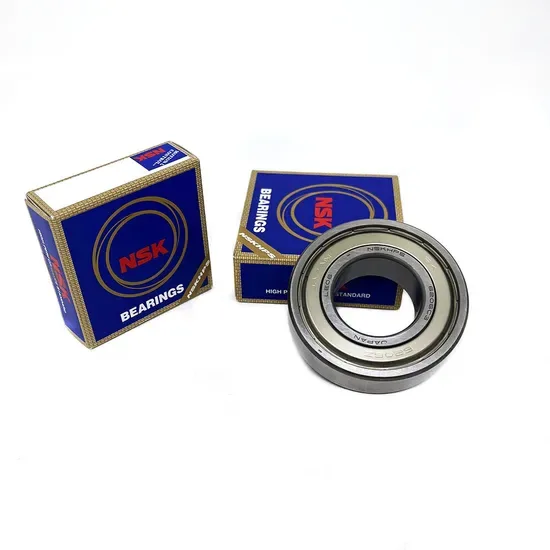 Deep Groove Ball Bearings Genuine NSK Deep Groove Ball Bearing 608 6204 6203 for Small Rotary Motors
 Deep Groove Ball Bearings Genuine NSK 16001 16002 16003 16004 16005 Deep Groove Ball Bearing for Winder
 Deep Groove Ball Bearings Genuine NSK 6903 6802 Deep Groove Ball Bearing for Machine Tool
Target Industries
Any alternative is marked separately on the quote and requires buyer approval.